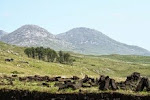
I know it's been a while butI will make an effort to try and post some more excerpts from the Connaught 1912 by Stephen Gwynn over the next while. It covers all of Connaught so I have tried to extract the mentions of Connemara for the moment. Interesting to see that hospitality and courtesy is something that was highlighted at that time and that some of the events that are still popular today get a mention -the Ballinasloe Horse Fair for example. Of course fishing also gets a mention and Ballynahinch Castle was as renowned then as it is today for it's hospitality and salmon fishing!
''..It is a poor Province, but it breeds notable men. I sat at dinner not long ago with three men who had been at school together in the West, poor lads all of them. One had become bishop of his diocese, one was the best know journalist in England and no mean force in politics; the third, perhaps, the greatest orator in America, something of a party to himself-but beyond all doubt a power.
It is perhaps well to remember such facts in visiting a country where poverty stares you in the face, where, at least in certain parts, it has become a disease. Courtesy in the poor is apt to seem obsequious; yet courtesy is of all things most native to Connaught, and it is finesh shown where the folk have acquired some stable security. I fished one afternoon with an old man in a lake in the mountain behind Leenane, a poor man but evidently not needy; he and his wife pressed on us the best they had to give, and because our fishing had been unsuccessful, wanted to refuse all payment. What we paid was little enough for those hours of easy paddling in the sunshine amid noble hills, and for the pleasure of that old boatman's wise, shrewd, and witty company.''
......'' All the north shore of Galway Bay is long,low and indented with a hundred creeks and bays. It is the paradise of fishermen, full of small lakes connected by little rivers up which the white trout run as nowhere else, and on a good day you may kill three or four dozen-but such fishings are not for the chance comer. The most famous and beautiful these lake and river systems is that of Ballynahinch, once the home of the Martins- trype of all that was kindest,oddest,wildest, and most feudal in the old feudal days. Miss Edgeworth came there on a journey in the early days of the last century , while the roads as yet were little more than a name, and the illness of a travelling companion detained here party for a stay that into weeks: lucky chance, to which we owe a picture, such as she could only sketch, of that primitive family hospitality, its table loaded with delicacies of the wilds, salmon, venison,oysters, and the rest presided over by a host used to administer patriarchal justice amongst the clansmen, sometimes by form of law sometimes by the strong fist. The hostess was a lady of the old school; but the strangest and most picturesque of all, was their one child, a daughter, the lovely ''princess of connemara' creature of the mountain no less than any Flor Mac Ivor with her train of ragged ghillies- yet instructed not only in the modern tongues but also in the ancient classics. She read the Greek poets, back there among her ragged mountain peaks: she spoke fluently a French which savoured oddly of the camp, for here teacher a waif from Napoleon's armies, and this young chieftainess had the French revolution in her heart. -God be with the the days now passed clean out of sight, if not out of mind. When the Martin estate went in the ruin that involved so many of the landed gentry sixty years ago, it at least perished nobly; for the Martin of that day beggared himself in the effort to feed the population that was starving by the thousands in the famine. Old folk remember still the droch-aimsir, the bad times,all over Ireland :yet in the nakedness of Connemara I have not heard any such awful tales as come down by word of mouth and written record relating to places far less out of reach of help.''........
Tuesday, April 20, 2010

Tuesday, March 2, 2010
Descriptions of Connaught in 1912
A few years ago at a book auction in Dublin I came across a set of 4 hardback travel books -Connaught Munster Lenster and Ulster -published in 1912 by Blackie & Son Ltd London Glasgow & Bombay. Pictured by Alexander Williams. Described by Stephen Gwynn.
I had forgotten about them until I was sorting out books recently and have decided to share some of it with you.
It feels a little bit like the programme http://www.rte.ie/tv/bloodoftheirish/prog1.html where they researched who we are and where we came from!!
''In Connemara the ''bawneen'' or sleeved waistcoat of whitish flannel is general and very becoming to its wearers, among whom are to be found the handsomest men in Ireland. Kerry women, who in certain parts really have the ''black-blue Irish hair and Irish eyes'', may perhaps hold their own even with the girls of Connaught; but for fine-looking men I would back Galway against any country in the British Isles. There is much talk of a Spanish strain on this coast, and undoubtly commerce was constant between the Iberian penisula: but the truth is that you have in western Ireland,as in western Spain, surivals of a race which the red haired people pushed off the good lands towards the limit of the sea. On the Claddagh at Galway I have seen a man at work in his cottage mending a net, who might have posed for the model of a Basque peasant; and the olive skinned fisher folk about the great mackerel curing station at Cleggan(near Clifden) are simply variants of a type that repeats itself along the coast of Spain.
I had forgotten about them until I was sorting out books recently and have decided to share some of it with you.
It feels a little bit like the programme http://www.rte.ie/tv/bloodoftheirish/prog1.html where they researched who we are and where we came from!!
There are references to most of Connaght but some interesting insights into
Galway/Connemara which I will share with your first.
Extracts from the 1st chapter
''Connaught -or Connacht, as it is more properly spelt or spoken-is geographically the best marked among the provinces of Ireland; and as usual other discriminations follow. I would not say that it is of all the provinces the most Irish; nobody has better to stand for Ireland than the boys of Wexford and at a Wexford Fair or meeting you will see scores of big farmers the very picture of Mr Punch's John Bull, only not so round about the abdomen. But Connaught, Connaughtment, and Connaught ways certainly come nearest to an Englishman's traditonal conception of Ireland and it's inhabitants; the stage Irishman is based upon Connaught characteristics. In West Mayo people do say ''shtruck''( or in moments of emotion ''shhtrruck''); and you can see still in places the traditional costumes. Shawled heads and bare feet are (thank goodness) to be met with all along the Atlantic seaboard; but the red petticoat(home-dyed with madder, though alas! aniline dyes are fast replacing the costlier and more beautiful crimson) is characteristic of Galway and Mayo; and in remote recessess of Joyce country and Connemara old and lovely fashions of braiding the hair and training ringlets to stray over the forehead still hold their own. In Connemara and on Aran the tall lad of thirteen may still though rarely be seen in the long petticoated shirt(his only garment) of red and blue flannel; but this is only a relic of sheer poverty.
''In Connemara the ''bawneen'' or sleeved waistcoat of whitish flannel is general and very becoming to its wearers, among whom are to be found the handsomest men in Ireland. Kerry women, who in certain parts really have the ''black-blue Irish hair and Irish eyes'', may perhaps hold their own even with the girls of Connaught; but for fine-looking men I would back Galway against any country in the British Isles. There is much talk of a Spanish strain on this coast, and undoubtly commerce was constant between the Iberian penisula: but the truth is that you have in western Ireland,as in western Spain, surivals of a race which the red haired people pushed off the good lands towards the limit of the sea. On the Claddagh at Galway I have seen a man at work in his cottage mending a net, who might have posed for the model of a Basque peasant; and the olive skinned fisher folk about the great mackerel curing station at Cleggan(near Clifden) are simply variants of a type that repeats itself along the coast of Spain.
Subscribe to:
Posts (Atom)